Shopify Prepaid Checkout: A setup for me Without Removing COD
By Brave Banana
Published 11 min read
A Shopify store can encourage more prepaid orders without forcing customers to abandon Cash on Delivery (COD). The right setup for me starts with understanding why customers choose COD and designing a better prepaid offer around their needs.
For Indian D2C brands, the objective isn't simply to increase online payments. It's to encourage customers who would otherwise choose COD to pay online, without unnecessarily sacrificing profit.
Why shouldn't Shopify brands remove COD completely?
Removing COD can make checkout less attractive to customers who are not comfortable paying an unfamiliar brand upfront. Keeping COD available while making prepaid more attractive gives customers a choice and gives the business an opportunity to improve its payment mix.
COD is a payment method where customers pay for an order when it arrives. Prepaid is a payment method where customers pay before the order is delivered.
Customers may prefer COD for several reasons:
They are purchasing from the brand for the first time.
They are unsure whether the product will match its pictures.
They worry about receiving the wrong product.
They are uncomfortable with refund delays.
They simply prefer paying after delivery.
A May 15, 2026 report by The Economic Times, titled "Nearly half of India's online orders are still COD", discusses why COD continues to matter in Indian e-commerce. It highlights customer trust, first-time buyers and concerns about delayed deliveries, incorrect products and refunds.
The report also cites industry estimates suggesting that close to half of India's online orders are still COD.
Source: The Economic Times: Why cash on delivery isn't fading in the UPI era
The important point is that a customer choosing COD isn't necessarily unwilling to make a digital payment. Sometimes, the customer simply needs more confidence in the brand.
How can a Shopify store make prepaid more attractive?
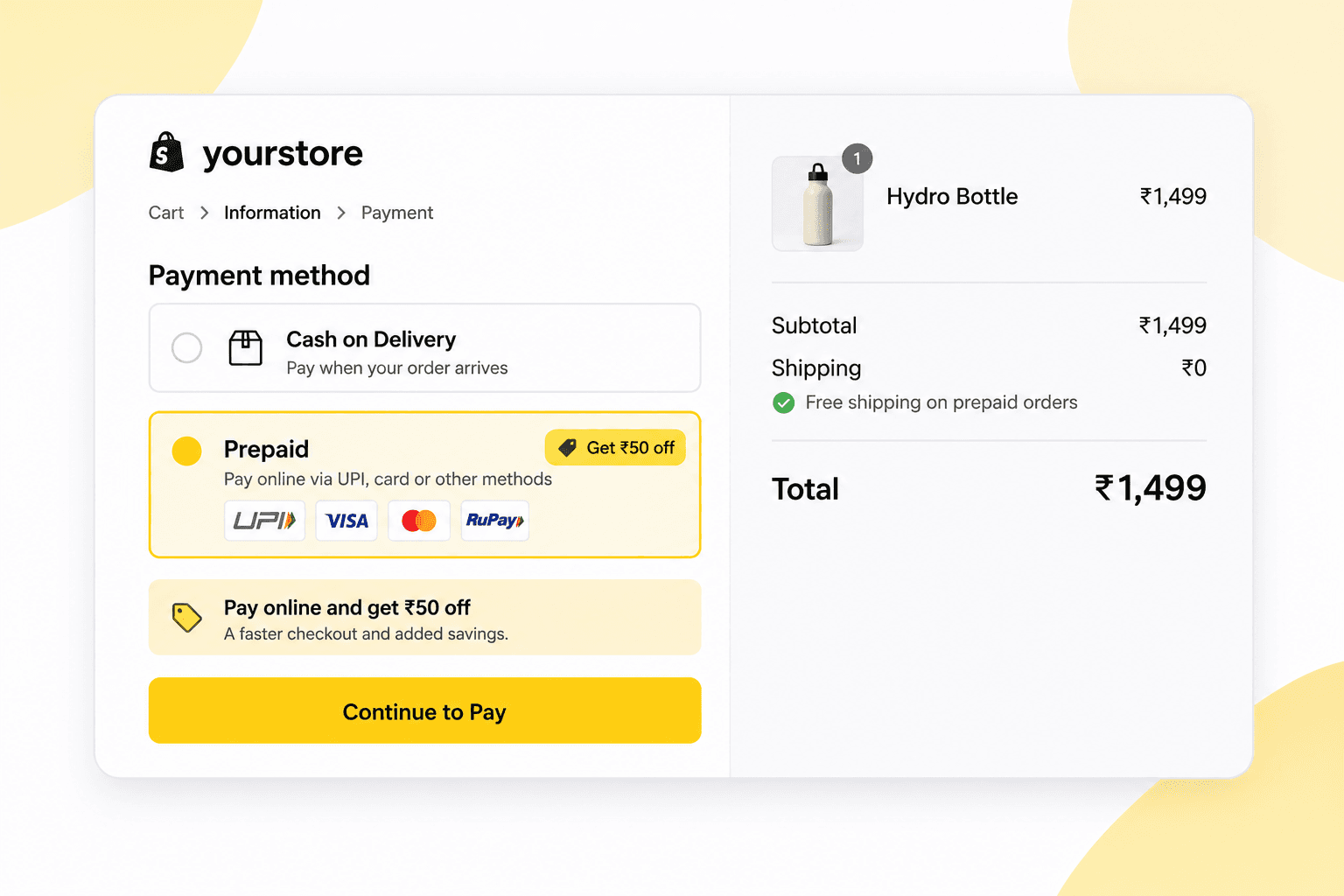
A Shopify store can encourage prepaid payments by offering a financial or practical benefit at checkout. The offer should be easy to understand and should not reduce the brand's contribution margin unnecessarily.
Here are four approaches worth considering.
1. Offer a small prepaid discount
A simple message such as "Pay online and get ₹50 off" gives customers an immediate reason to choose prepaid.
The discount should be calculated using the brand's actual margins and delivery costs. A fixed discount that works for a ₹2,000 product may not make sense for a low-margin ₹399 product.
2. Offer free shipping on prepaid orders
Shipping charges can influence a customer's final checkout decision. A brand can test free shipping for prepaid orders while retaining its regular shipping policy for COD orders.
For example:
COD: Product price plus applicable shipping.
Prepaid: Product price with free shipping.
The brand should calculate the actual shipping expense before introducing this offer.
3. Give customers a useful free gift
Instead of reducing the product price, a brand can offer a complimentary sample, mini product or relevant add-on for prepaid orders.
This can make the offer feel more valuable without directly discounting the main product. However, the gift's purchase, packaging and fulfilment costs still need to be considered.
4. Offer priority dispatch
A brand can give prepaid orders priority in its fulfilment process.
For example, the checkout can communicate that prepaid orders receive priority dispatch. This promise should only be used when the warehouse can consistently support it.
Priority dispatch does not automatically mean faster delivery. The courier's performance and delivery location still matter.
What does research say about customers choosing prepaid?
Research suggests that some customers may prefer prepaid payments or become more willing to pay online when an attractive incentive is available. However, survey findings should not be treated as guaranteed results for every Indian D2C brand.
Shiprocket's 2023 report, "eCommerce in the New Bharat and Its Future", surveyed 1,000 Indian shoppers, 500 international shoppers and 500 brands.
Its Indian consumer findings include:
76% of surveyed Indian consumers preferred prepaid payments over COD.
57% preferred UPI among prepaid payment options.
The report also estimated that brands could potentially convert 88% of consumers to prepaid orders by offering attractive discounts.
These figures come from a particular survey and its methodology. They should not be presented as the current payment preferences of all Indian online shoppers.
Source: Shiprocket: eCommerce in the New Bharat and Its Future
Unicommerce's FY26 India D2C report provides another useful perspective. It describes shipment and transaction data from more than 6,000 brands and 410 million shipments.
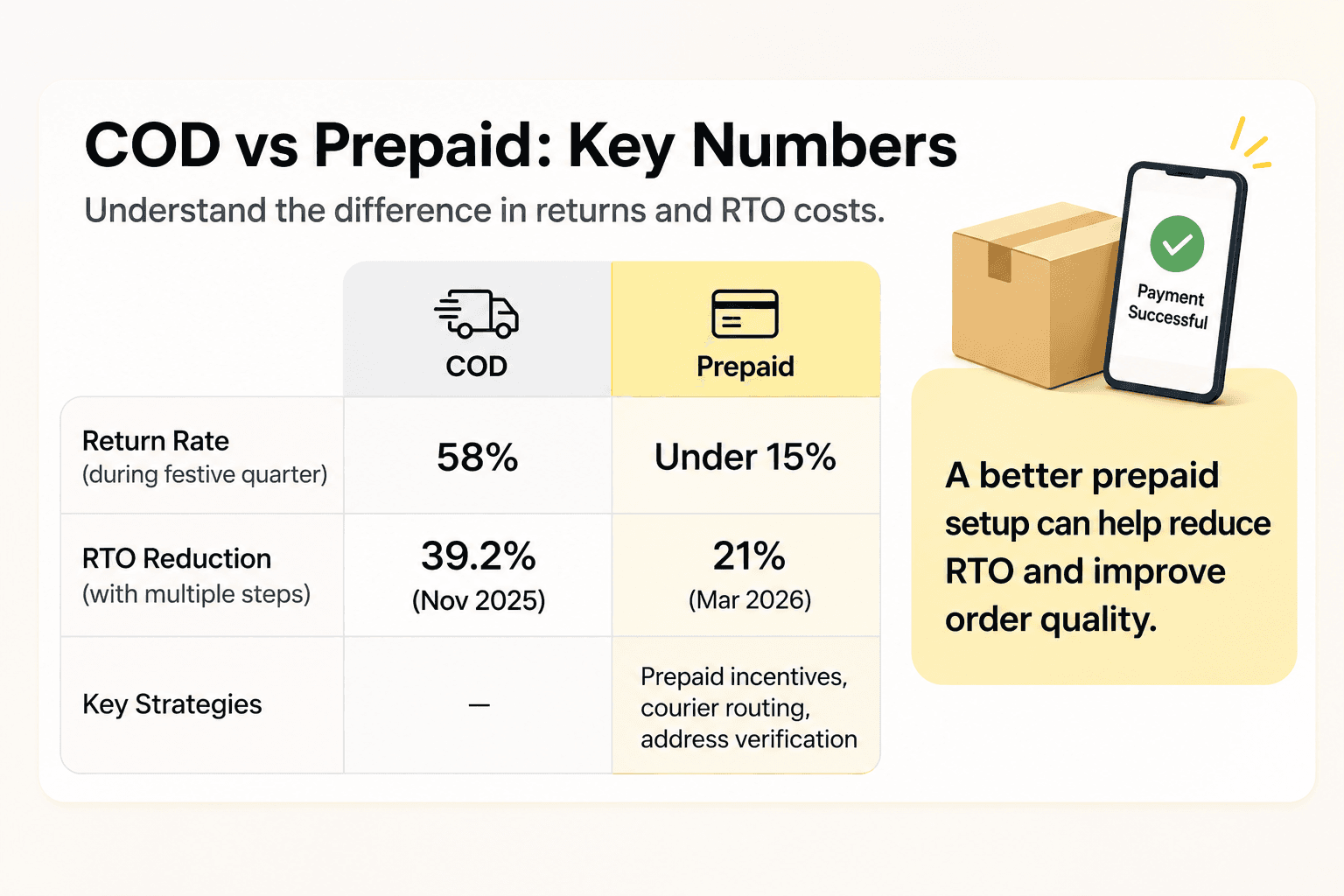
The report states that during the festive quarter, COD orders had a reported return rate of 58%, compared with under 15% for prepaid orders.
These are report-specific findings, not universal rates that every Shopify store should expect.
The report also describes RTO improvements associated with three combined interventions:
Prepaid incentives.
PIN-code-level courier routing based on delivery performance.
Address verification before dispatch.
Unicommerce reports that RTO among the optimised brands described declined from 39.2% during the November 2025 festive peak to 21% by March 2026.
It would be misleading to attribute the entire improvement to prepaid discounts alone.
Source: Unicommerce: The New D2C Playbook, India D2C Report FY26
The takeaway is simple. Prepaid incentives can be useful, but they work best as part of a broader strategy involving customer trust and reliable delivery operations.
How does trust influence prepaid checkout decisions?
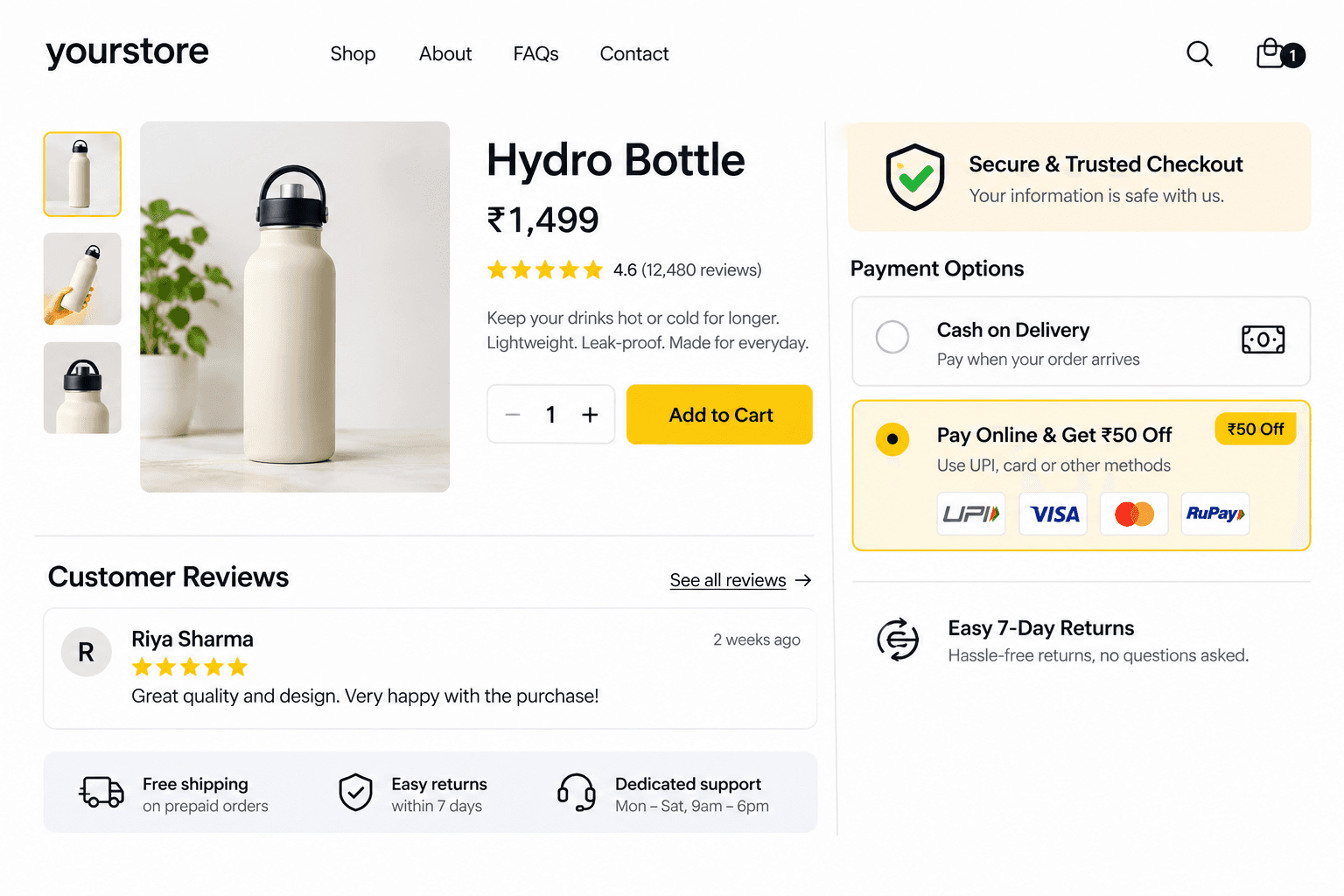
Trust is just as important as the discount when a customer decides whether to pay online. A ₹50 incentive may not convince someone who is worried about receiving the wrong product or getting their money back.
A Shopify checkout should make essential information easy to find.
Consider displaying or linking to:
Clear product descriptions and accurate product photographs.
Genuine customer reviews and ratings.
Delivery estimates based on the customer's PIN code.
A clear return and refund policy.
Accessible customer support details.
Recognisable and supported payment options.
For Indian customers, UPI is an important payment option to consider alongside cards and other supported digital payment methods.
A brand should also make sure that its payment gateway and refund process are reliable. A good prepaid offer cannot compensate for a checkout experience that creates doubts about the brand.
How do you calculate whether a prepaid discount saves money?
A prepaid incentive makes business sense only when the expected savings are greater than the cost of the incentive and other additional expenses.
Consider this hypothetical example.
These are illustrative assumptions, not industry benchmarks or actual client results.
Metric | Example |
COD RTO rate | 30% |
Prepaid RTO rate | 5% |
Cost of one RTO | ₹240 |
Prepaid incentive | ₹40 |
The difference between the two RTO rates is 25 percentage points.
Expected RTO cost saved for one genuinely converted COD order:
(30% - 5%) × ₹240 = ₹60
The brand expects to save ₹60 in RTO costs for each order shifted from COD to prepaid, before accounting for other expenses.
Now consider 20 customers who would otherwise have selected COD but choose prepaid after seeing the offer.
Calculation | Amount |
Expected RTO cost saved | ₹1,200 |
Prepaid incentives paid | ₹800 |
Potential net saving | ₹400 |
The calculation assumes that all 20 customers genuinely switched from COD and that the example RTO rates apply to their orders.
The result changes if the brand gives ₹40 off to every prepaid customer, including people who would have paid online anyway.
This is called incentive leakage. The brand spends money without necessarily changing customer behaviour.
The objective should be to increase profitable prepaid orders, not simply increase the prepaid percentage.
A useful starting formula is:
Expected RTO saving = (COD RTO probability - Prepaid RTO probability) × Cost per RTO
Compare the result against the incentive, payment processing costs, refunds, cancellations and any other additional expenses.
How should brands decide which customers receive prepaid offers?
Not every customer needs the same incentive. A repeat customer who has successfully received several orders may respond differently from a first-time buyer who does not yet trust the brand.
A practical segmentation approach can help.
Customer segment | Possible approach |
Repeat customers | Test a small prepaid reward or loyalty benefit. |
First-time customers | Build trust with reviews, policies and clear delivery information while retaining COD. |
High-RTO PIN codes | Investigate courier performance and test suitable prepaid incentives. |
High-value orders | Evaluate partial payment or suitable upfront payment options. |
Existing prepaid customers | Avoid unnecessary discounts for customers who already prefer online payment. |
These are starting points for testing, not universal rules.
A high-RTO PIN code does not automatically mean that customers should be pushed towards prepaid. The problem may be poor courier performance, address issues or delivery limitations.
Brands should examine payment data alongside PIN-code-level delivery performance before deciding where to introduce incentives.
For example, a brand may discover that one courier performs well in Surat but has repeated delivery failures in certain PIN codes outside Gujarat. Offering a larger prepaid discount in those locations will not necessarily solve the underlying problem.
The brand should investigate the delivery issue first.
How can you implement prepaid offers on Shopify?
Shopify supports different discount structures and payment customisations, but prepaid-only discounts may require additional implementation work. The available approach depends on the store's checkout configuration, payment gateway and Shopify plan.
Shopify's automatic discounts support several discount types:
Amount-off discounts.
Free-shipping discounts.
Buy X Get Y discounts.
App-based automatic discounts.
However, a discount that applies specifically when a customer selects prepaid should not be assumed to work through one standard Shopify setting.
Shopify Payment Customization Functions allow supported payment methods to be renamed, reordered or hidden. They also support certain payment-term and review requirements.
They are not a universal native solution for applying a discount based only on the selected payment method.
For more details, refer to:
Shopify Payment Customization Function API
Shopify Checkout Customization Documentation
What should a Shopify prepaid checkout setup include?
Keep Cash on Delivery available where the brand wants to support it.
Display prepaid payment options clearly, including supported UPI and card methods.
Communicate the prepaid benefit before the customer makes a payment decision.
Check whether the chosen discount method is compatible with the store's checkout setup.
Test the complete purchase, payment confirmation, cancellation and refund journey.
Track the financial impact after launch.
[ADD REAL EXAMPLE: Show a Brave Banana Shopify checkout implementation with COD and prepaid options, the incentive displayed, and the actual technical approach used.]
For brands planning a new Shopify store or redesign, checkout payment choices should be considered as part of the overall store experience, not as an afterthought.
What should you measure after introducing a prepaid offer?
A higher prepaid share does not automatically mean the business is making more money. Brands should measure checkout performance and order profitability together.
Track these metrics:
Metric | What it tells you |
Prepaid share | Percentage of orders paid online. |
COD-to-prepaid conversion | Number of COD-intending customers who switch. |
Overall checkout conversion | Whether the offer affects completed purchases. |
RTO by payment method | Delivery failure differences between payment cohorts. |
Incentive cost | Total discounts, cashback and gifts provided. |
Contribution margin per order | Money retained after relevant variable costs. |
Refund and cancellation rate | Whether prepaid orders create additional losses. |
A controlled experiment is a useful way to compare different offers.
For example, divide eligible customers into three groups:
Group A sees the regular checkout.
Group B sees a ₹40 prepaid incentive.
Group C sees free shipping on prepaid orders.
Keep other checkout elements as similar as possible. Compare purchase conversion, prepaid share, RTO and contribution margin across the groups.
The winning offer is not necessarily the one with the highest prepaid percentage. It is the one that improves the business's overall economics without creating unnecessary checkout friction.
[INTERNAL LINK: Shopify checkout optimisation for Indian D2C brands]
Sources
Nearly half of India's online orders are still COD. Why cash on delivery isn't fading in the UPI era - The Economic Times, May 15, 2026.
The New D2C Playbook: Why Operations Beat Marketing, India D2C Report FY26 - Unicommerce.
eCommerce in the New Bharat and Its Future - Shiprocket, 2023.
Shiprocket eCommerce in the New Bharat and Its Future, Original Report PDF - Shiprocket.
Automatic discounts - Shopify Help Center.
Payment Customization Function API - Shopify Developer Documentation.
Customizing payment methods and delivery options at checkout - Shopify Help Center.
Questions
Should I remove Cash on Delivery from my Shopify store to reduce RTO?
Not necessarily. Removing COD can discourage customers who are not comfortable paying an unfamiliar brand upfront. A better starting point is to retain COD while testing prepaid benefits and improving delivery verification, customer trust and courier performance.
What is a good prepaid discount for Indian D2C customers?
There is no universally correct prepaid discount. The amount should depend on product margins, shipping expenses, average order value and expected RTO savings. Test different incentives with a controlled customer group before applying them across the entire store.
Can Shopify automatically give discounts only to prepaid customers?
Not through every standard Shopify discount setup. Shopify supports automatic discounts, but applying an offer specifically based on the selected payment method can require a compatible app, payment integration or custom implementation. Check the store's checkout configuration and current Shopify restrictions before promising this functionality.
Is UPI better than Cash on Delivery for Shopify brands?
UPI can make online payment convenient for customers who are comfortable paying upfront, but it does not replace the need for COD. Brands should offer supported digital payment options while considering customer trust, refunds, payment failures and delivery performance.
Does prepaid payment guarantee that an order will not become RTO?
No. Prepaid orders can still be returned or fail delivery because of incorrect addresses, customer unavailability, courier problems or other issues. Prepaid incentives should be combined with address verification and reliable delivery operations rather than treated as a complete RTO solution.
Want help with your Shopify store?
Brave Banana builds and fixes Shopify stores for Indian brands. Send us a message on WhatsApp and tell us what you are working on.
Opens WhatsApp with a short message you can edit before sending.